Fascinating look at "The Beauty of Data Visualization"
David McCandless turns complex data sets like worldwide military spending, media buzz, Facebook status updates and more into beautiful yet simple diagrams. He proposes design as the tool we use to navigate today’s information glut, finding unique patterns and connections that may just change the way we see the world. (Recorded at TEDGlobal 2010, July 2010 in Oxford, UK. Duration: 18:17)
Showing posts with label technology. Show all posts
Showing posts with label technology. Show all posts
Monday, June 13, 2011


Tuesday, June 7, 2011
Get a grip on Groupwise
Whether you have 10+ years of accumulated email or just this year’s, this hands-on workshop provides an antidote for email disorganization as well as extremely useful guidelines for handling email overload so that you can reclaim time for other tasks.
How will you implement what you have learned in the workshop in your teaching this fall?
 |
| Online Groupwise resources in Sakai here |
Your web presence: the good, the bad, & the ugly
What is your web presence? Why might it matter? This workshop helps you to answer these questions and examines the options to create or update your Scripps College website (pages.scrippscollege.edu/~yourusername) or department website using
How you will implement what you learned in this workshop in your teaching this fall?
- Dreamweaver web design software
- the Faculty Site Starters program
- iWeb and WordPress software
- perhaps Blogger should have been included....
How you will implement what you learned in this workshop in your teaching this fall?
Mobile Computing ~ who, what where, when &, most importantly, why
Mobile computing swept into our lives @ an amazing pace. This workshop explores the pedagogical, professional and personal potentials & pitfalls of mobile devices (smart phones, iPads, etc.
Online workshop Resources in Sakai here
How you will implement what you learned in this workshop in a fall 2011 course?
Online workshop Resources in Sakai here
How you will implement what you learned in this workshop in a fall 2011 course?
Tuesday, January 18, 2011
State of the Internet 2010
Video is from Feb 2010. Thought-provoking stats....
JESS3™ / The State of The Internet from JESS3 on Vimeo.
JESS3™ designed and animated this for the JESS3™ lecture at AIGA Baltimore in Feb 2010.
Wednesday, April 7, 2010
Apple iPad in higher education: a 1-day perspective
I'm trying to write this post using an 1-day old iPad. At this point, except for the blog title and labels, writing a post from within the Google blogger interface (i.e., bringing up the beautiful big iPad touch keyboard) is only possible using the Edit HTML function, not the simple Compose WYSIWYG. Slow and tedious.... I'll have to finish this later on a real computer....
Tuesday, February 9, 2010
Parody of "The Office" - challenges of teaching with technology
Online on YouTube - 1/28/10 with these tags:
- Final MassComm Video
- the class the office
- technology classroom professor students
- floppy disk powerpoint skype clicker projector
- DU university of denver
Monday, February 25, 2008
Geek from birth or nurtured technology
Veronica Hart '07, Assistant Director of Technical Services, Development
Overview: How technology in her life inspired Veronica to come to Scripps, minor in computer science, work for IT, and finally get a wonderful job! Quick overview of how technology and education have crossed paths in her life from working with the dynamics of learning with Lego Mindstorm robots to IT-FITS training to her current job in Development Services.
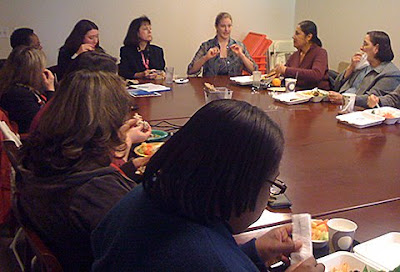
Overview: How technology in her life inspired Veronica to come to Scripps, minor in computer science, work for IT, and finally get a wonderful job! Quick overview of how technology and education have crossed paths in her life from working with the dynamics of learning with Lego Mindstorm robots to IT-FITS training to her current job in Development Services.

Are people who are comfortable with computer technology simply born that way? Or is tech savvy nurtured by experience? Although she feels like she was "geek from birth," Veronica Hart kicked off the Spring 2008 IT Tech Bytes Brown Bag lunch series with an engaging, insightful, and technology-free presentation about the factors that led her to embrace computing.
Veronica shared how her family, early involvement with computing gaming, and various experiences as a student at Scripps led her to her current position as Assistant Director of Advancement Services.
Veronica's father worked in the Los Alamos Lab in New Mexico; built the first electronic slot machine. Her father insured her access to computers and modeled fascination and enthusiasm for computers. Veronica learned to use the Internet in school. For her, the turning point was the discovery of a popular online multi-player game. She became so adept at Aetolia, a text-based medieval fantasy MUD, that the game makers asked her to help them to develop the game while she was still in high school. Eventually, her love of fantasy found a home in computer science. Before coming to Scripps, Veronica also enjoyed an internship working with Lego Mindstorm robots at the Santa Fe Institute.
Why did Veronica choose Scripps? Like many computer geeks, Veronica's early experience with computers came from experience, not formal study. She took no computer science classes in high school. Veronica wanted to go to college in Southern California because of visits to her grandmother's home in Alta Dena. When she stepped on campus, she knew that Scripps was it.
At Scripps, Veronica had the opportunity to build games. She began her undergraduate studies as a Physics/Computer Science major. There were only two other Scripps women CS majors in her class. She took as many classes at Pomona and Mudd as at Scripps, including the first class on Gender and Computing at Harvey Mudd. After two years she switched to Studio Arts with a minor in CS. She got involved with the Game Developers Conference. Her senior thesis was on "Breaking Gender Stereotypes with Games," specifically with World of Warcraft, a massive multiplayer online role-playing game.
Veronica wrote the Users Guide for the data projector at the lunch session. She worked for Scripps IT as a lab consultant her freshman year, and moved up in the department over the next four years. Veronica was the first student instructional technology assistant hired for the IT-FITS (Faculty In-Office Technology Support) program. As an art major, working for IT gave her a direct daily connection to technology. She learned a lot about hardware, software, training, teamwork, and problem solving that excited her. Her current position in Development benefits from these experiences-and lets her work with code and databases.
Q&A
Many students seem so wrapped up in texting that they don't feel comfortable with face-to-face interaction. What are some things that helped you stay connected to the physical world?
The kinds of things that Scripps does: movies on the lawn and taking classes like sculpture. Maybe no cell phones should be allowed at events.
You explain technology so well. Do you think that women are better at explaining these things?
I think that women are better translators between techies and non-techies. When I'm with my Mudd friends, sometimes I get lost. There are times when you have to be social. Scripps helped me develop my communications skills.
Do you think that the place to approach young women is at the high school level so they can find out about women in CS?
Yes. More and more women are in computer science as role models.
If you wanted to go to school in Southern California, why not UCLA or other colleges with more CS emphasis?
I didn't have the technical knowledge. No CS courses in high school. Many of the boys teach themselves. When I first stepped foot at Scripps, I knew it was the right place. The architecture, the physical campus felt like a place where people are well taken care of. There was an appreciation for being outside too. For education. For women.
How did they sell Scripps to you?
The multi-college consortium — I could take classes at all the colleges. I sat in on HMC classes.
When you started at Scripps, was there a big transition in learning? How did you make that transition?
Yes. Outdoor orientation really helped. A great start. The smallness of the college... Finding professors for advice. I never felt a lack of resources. I never expected to feel that special treatment as a staff member too. I'm working with great people. I'm constantly grateful for the opportunity to give back.
Subscribe to:
Posts (Atom)